
Any Renal Replacement Therapy (RRT) may be considered successful if it is clinically effective, patient friendly, economically viable and sustainable. After working on this project for over four years and gaining first hand experience, we realized that the present-day RRTs have several shortcomings.
Dialysis of the blood is a membrane separation process which uses a synthetic or a natural membrane. We went back to the science of membrane separation to understand how uremic solutes are removed from the patient’s blood during dialysis.
We realized that blood components such as platelets and proteins, clog the pores of the membrane during dialysis, significantly reducing its efficiency. This phenomenon is termed as concentration polarization in membrane science. It may be a major contributing factor to Dialysis Inadequacy, a problem faced by as high as 50% of the dialysis patients in the developing countries. Accumulation of the toxins in the patient’s body leads to increased uremic symptoms like nausea, vomiting and aversion to food. The poor efficacy of the treatment results in poor quality of life of the patients in spite of undergoing regular dialysis.
In a study conducted by our team, it was evident that Concentration Polarization was affecting the rate of diffusion of toxins (known as clearance) in hemodialysis sessions of 15 patients as shown below. A reduction in clearance values by as high as 28% was observed during one of the four-hour hemodialysis sessions.
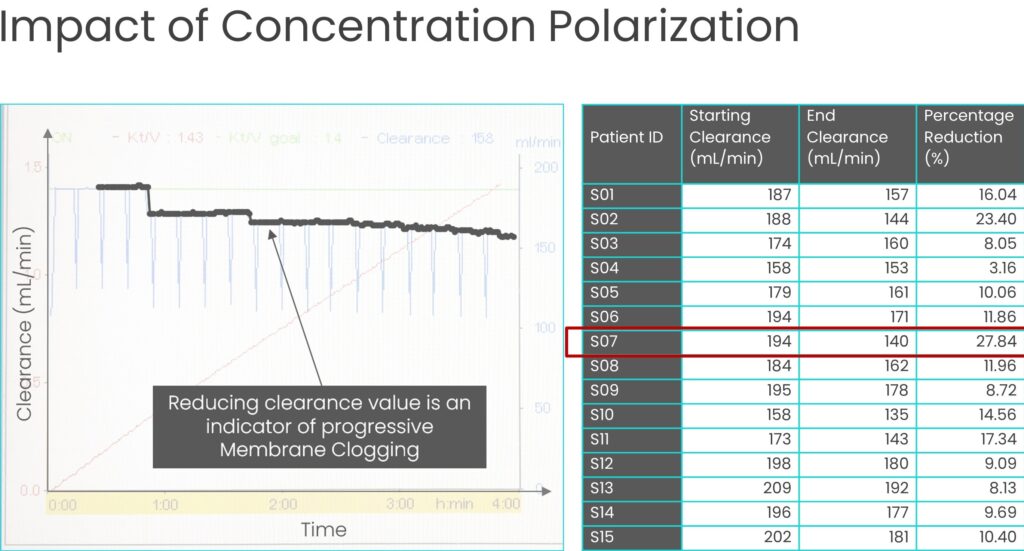
Any RRT utilizing a membrane to regulate the concentration of solutes in blood is susceptible to concentration polarization and its detrimental effects on the process efficiency. A solution is therefore necessary to prevent intra dialytic concentration polarization.
Introducing Ultrasonic Dialysis, a solution that utilizes ultrasonic waves to reduce concentration polarization occurring during any form of dialysis utilizing membranes. An Ultrasonic Transducer is attached to the membrane housing during dialysis. A Control System supplies specific electrical signals to the transducer. These electrical signals are converted into ultrasonic waves by piezoelectric crystals in the transducer.
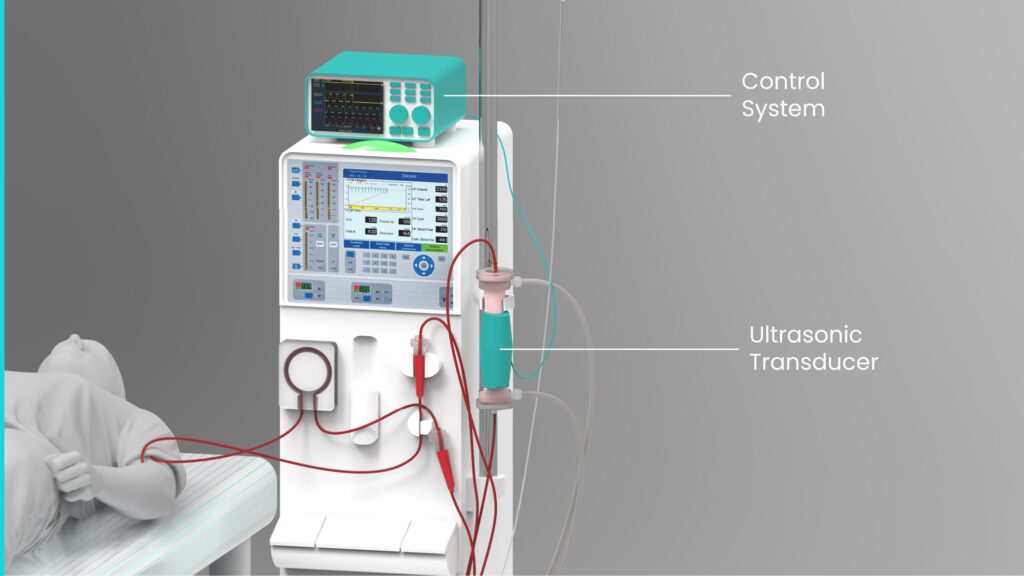
The waves are transmitted to the dialysis membrane surface, causing a stirring and cleaning effect on it. They dislodge the particles clogging the pores of the membrane. The mild turbulence thus created, promotes diffusion and increases the rate of removal of toxins from blood. Ultrasonic Dialysis may be effective even for RRTs operating at low blood and dialysate flow rates.
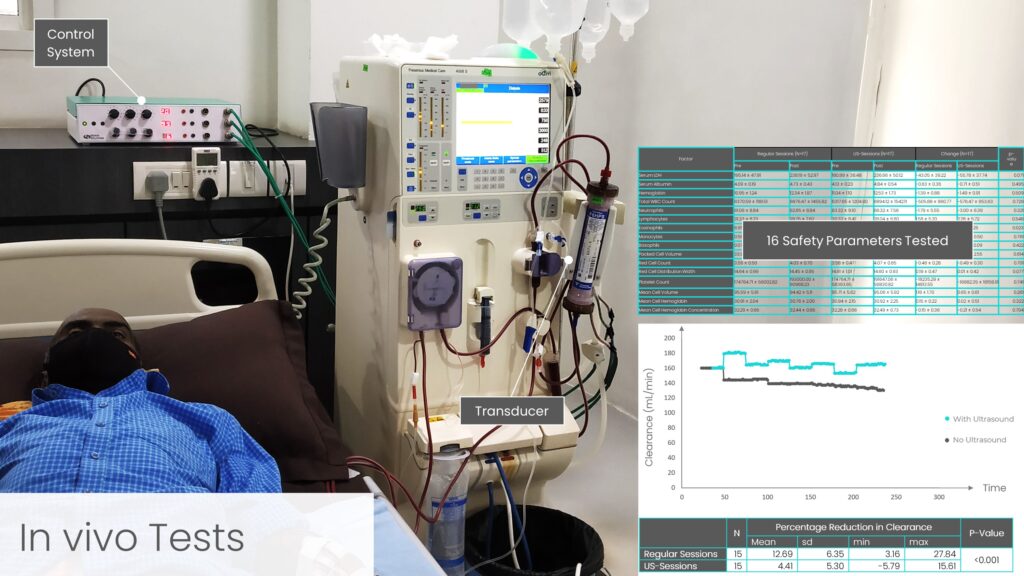
After several iterations and tests, we have arrived at technical parameters that work well for hemodialysis. The solution has shown encouraging results in a pilot study consisting of 15 hemodialysis patients. The Ultrasonic Device was found to reduce membrane clogging significantly and was found to be safe for the patients and the dialysis equipment
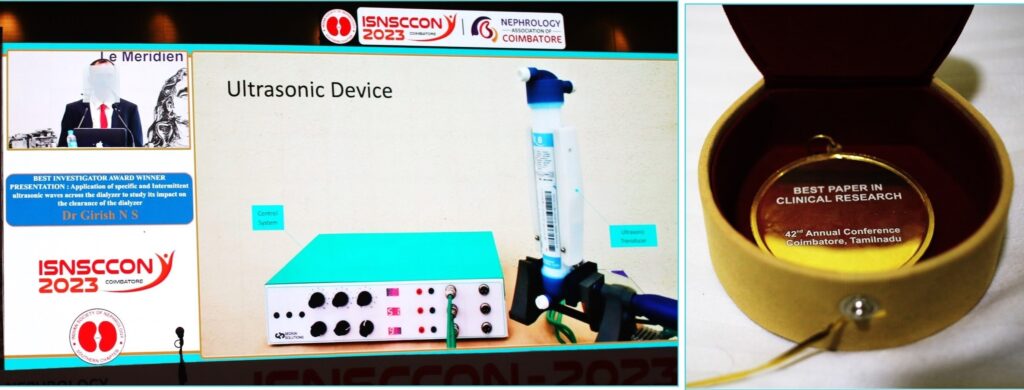
The project received the ‘Best Research Paper’ award at the Indian Society of Nephrology (South Chapter) Conference 2023.
There is no solution that addresses the problem of membrane clogging occurring during dialysis. Ultrasonic Dialysis is a first in the world solution that reduces the clogging of the dialysis membranes. It is applicable to any RRT that relies on a membrane to regulate solutes in the patient’s blood. We have been granted a Japanese and an Indian patent for the same.
Ultrasonic Dialysis can make any RRT more clinically effective, patient friendly, economically viable and sustainable. We believe that it can become a standard method of performing dialysis.
Please feel free to get in touch with us if our work excites you! (sedigns@gmail.com)